

Money Notes

Money Notes
Few financial conversations carry as much emotional weight as those that happen inside a family. More families are turning to intrafamily loans and outright gifts as deliberate wealth transfer tools, moving capital where it is needed most. The core question is always the same - loan or gift? They are not the same thing, and treating one like the other can create unwanted tax exposure and potential familial strife. What matters is understanding the rules, the risks, and the relationship dynamics before any money changes hands.
The same considerations apply regardless of which direction support flows. Parents lending to adult children face the same IRS rules as adult children stepping in to help an aging parent. This article addresses both.
Learn how a properly structured intrafamily loan - or a well-timed gift - could fit into your family's wealth transfer strategy. Contact BLBB Advisors to start the conversation.
An intrafamily loan is a formal arrangement between family members - structured with a defined interest rate, a repayment schedule, and a written agreement - as opposed to an outright gift, which carries no expectation of repayment. Common uses vary by generation:
A transfer can go directly to an individual or to a family trust, each with different implications for control, creditor protection, and estate planning.
The Applicable Federal Rate (AFR) is the IRS-published minimum interest rate required on a family loan to avoid reclassification as a gift. It varies by term and is updated monthly at irs.gov:
When a loan charges no interest or interest below the AFR, the IRS may impute interest income to the lender and simultaneously treat the forgone amount as a taxable gift. This is one of the most common and entirely avoidable missteps in family lending. Interest received by the lender is taxable income; whether the borrower can deduct it depends on how the funds are used - mortgage, investment, and business interest are each treated differently.

An undocumented arrangement is the easiest thing for the IRS to reclassify as a taxable gift - and just as easy to become the source of a family dispute over what was actually agreed upon. A written loan agreement is not bureaucratic overreach; it is how you protect the arrangement, the relationship, and everyone involved.
A sound family loan agreement should include:
When helping a parent, documentation matters even more. Undocumented transfers can complicate Medicaid eligibility under the look-back rules1, create ambiguity in the parent's estate, and invite conflict among heirs. Coordinating with an elder law attorney is strongly advisable when Medicaid may eventually be a factor.
The IRS distinguishes a loan from a gift based on documentation and behavior, not intent. A loan requires an expectation of repayment and interest at or above the AFR. A gift carries no repayment obligation. An 'informal loan' without written terms or payment history will likely be treated as a gift - with all the tax consequences that follow.
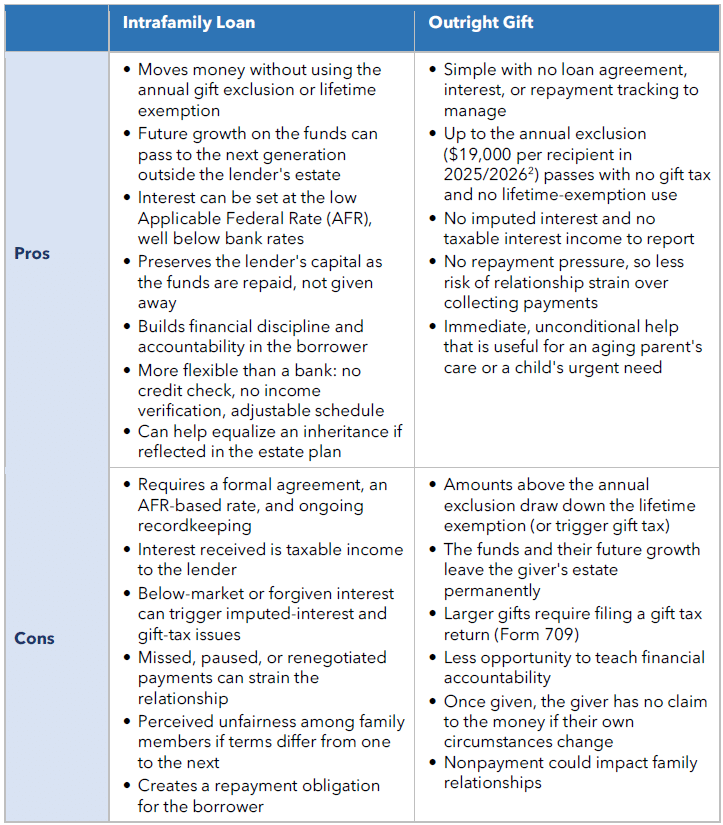
A hybrid path also exists: a loan can be partially forgiven over time, with each annual forgiveness treated as a gift within the exclusion. This must be handled carefully - if the arrangement appears to have been a gift from the start, the IRS may recharacterize the entire transfer.
Once the tax rules and documentation requirements are clear, the next step is deciding whether an intrafamily loan or gift makes sense for your family in practical terms. A transfer may work well on paper and still create strain in real life. Before lending money to family - or making a substantial gift to a family member - it is important to think through not only the financial impact, but also the expectations and emotions that may come with it.
Money rarely damages family relationships on its own. More often, the problem is uncertainty - about repayment, fairness, or intent. Asking the right questions before moving forward can help families approach an intrafamily loan or gift with greater clarity, stronger communication, and a better chance of preserving both wealth and relationships.
Whether the right answer is an intrafamily loan or an outright gift, the structure matters. Before money changes hands, families should make sure the arrangement fits their broader financial plan, estate strategy, and tax picture. The right guidance can help clarify not only how to structure the transfer, but whether it should happen at all.
Considering a loan or gift to help a family member reach a financial goal or weather a difficult season? BLBB Advisors are here to help you think through which approach fits your family's wealth transfer and planning strategy. Schedule a Consultation
1 https://www.medicaidplanningassistance.org/medicaid-look-back-period/
2 https://www.irs.gov/businesses/small-businesses-self-employed/whats-new-estate-and-gift-tax
Disclosure
Investment advisory services are provided by BLBB Advisors, a Pennsylvania-based investment advisor registered with the Securities and Exchange Commission under the Investment Advisers Act of 1940. SEC registration does not imply any particular level of skill or training. Additional information about BLBB is available in our current disclosure documents which are available on BLBB’s website (www.blbb.com) or the SEC’s public disclosure database (IAPD) at www.adviserinfo.sec.gov. Past performance is not indicative of future results and investing involves a risk of loss, including a loss of principal.
BLBB does not offer legal or tax advice. Please consult the appropriate professional regarding your individual circumstances.
Click below to receive our latest insights on a variety of financial topics