

Money Notes

Money Notes
Receiving an inheritance can bring both opportunity and complexity. The decisions you make in the initial few months can significantly impact your financial future. We have provided some practical steps to help you navigate inherited wealth and avoid common pitfalls, enabling you to establish a sustainable financial legacy.
Contact us to schedule a consultation for personalized guidance.
First, we advise our clients to give themselves some time to grieve, process their emotions, and avoid making hasty financial decisions for at least six months. Taking this time to pause allows you to think clearly about your long-term goals rather than reacting impulsively to your new circumstances.
Sarah and Michael, both in their early 40s with two children, were diligent savers maxing out their 401(k)s with a modest investment account of about $180,000.
When Sarah's father passed away unexpectedly, she inherited $850,000—split between an inherited IRA ($520,000), a brokerage account ($280,000), and cash ($50,000).
Initial reaction: Relief. College was covered. Early retirement seemed possible. Kitchen renovation—finally!
Reality check: Within weeks, they had competing questions:
Three months later, they'd made zero decisions and started arguing about money for the first time in their marriage.
The solution: Working with our team, we identified $47,000 in tax savings through strategic distribution timing, restructured their portfolio for their actual time horizon, coordinated updated estate protections, and created a clear decision-making framework.
Two years later, Sarah reflected: "The inheritance was supposed to make life easier, but it was creating stress and paralysis. Having someone who'd seen this a hundred times before made all the difference."
Starting point? Knowing exactly what you have inherited.
Inheritance comes in various forms, and understanding what you've received is foundational to managing it effectively. BLBB Advisors is here to talk you through the steps and explain what may be coming your way. Your inherited assets may include:
Each asset type carries distinct tax implications, liquidity considerations, and management requirements.
Create a comprehensive inventory of all inherited assets, including account numbers, locations, estimated values, and any associated costs or obligations. This inventory becomes your roadmap for all subsequent financial planning.
Before discussing what to do with your newly inherited wealth, it's crucial to understand what NOT to do. Common mistakes can permanently derail your financial security:
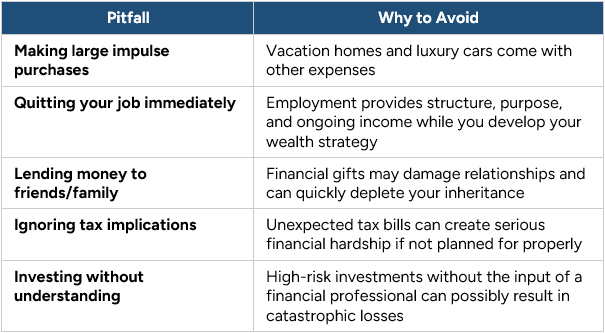
Remember: wealth preservation requires discipline and patience. The decisions you avoid making today may be just as important as those you make tomorrow.
Tax considerations can be among the most important aspects of inheritance planning. Understanding your tax obligations can help prevent costly surprises and enables strategic decision-making.
Federal vs. State Inheritance Taxes
Good news: the federal government does not impose an inheritance tax on beneficiaries. While there is a federal estate tax, it only applies to estates exceeding $15 million (as of 2026) and is paid by the estate itself, not by you as the beneficiary.
However, six states currently levy inheritance taxes: Iowa, Kentucky, Maryland, Nebraska, New Jersey, and Pennsylvania. Rates and thresholds vary significantly by state, making consultation with a tax professional essential if you live in or inherit from someone in these states.
Special Considerations for Inherited Retirement Accounts
Inherited IRAs and 401(k) accounts carry unique tax implications. Under current law, non-spousal beneficiaries must generally withdraw all funds within 10 years of the original owner's death.1 These withdrawals count as ordinary income and can push you into higher tax brackets if not managed strategically. Spousal beneficiaries have more flexible options, including treating the account as their own.
Working with experienced professionals—a CPA and your BLBB financial advisor for inheritance planning—can help you minimize tax liability through strategic timing of asset sales, retirement account distributions, and charitable giving strategies.
Investing inherited wealth requires a different mindset than investing earned income. This is likely a one-time opportunity to build substantial long-term security—there are no do-overs.
Assess Your Risk Tolerance and Time Horizon
Your investment strategy should reflect your age, financial obligations, income stability, and comfort with market volatility. A 30-year-old with steady employment can typically accept more market risk than someone nearing retirement. Be honest about your emotional response to potential losses.
Diversification Is Essential
Concentrating inherited wealth in a single investment, sector, or asset class is not advisable. Speak with your financial advisor about your unique circumstances and how diversification remains the most reliable protection against possible catastrophic loss.
While self-directed investing is possible, substantial inheritances often benefit from professional management. As a fiduciary financial advisor, BLBB can provide objective guidance, help avoid emotional decision-making, and coordinate with your tax and legal professionals.
The risks of going it alone include inadequate diversification, poor timing decisions, excessive trading costs, and failure to coordinate investments with your overall financial plan. Even sophisticated investors often benefit from a second opinion on significant financial decisions.
Inheriting wealth is a profound responsibility. By pausing to grieve, understanding your options, avoiding pitfalls, addressing tax implications, and working with your financial advisor to create a plan, you can honor that legacy while building security for future generations.
Remember, the most successful inheritors are those who resist the temptation to rush, seek expert guidance when needed, and make deliberate decisions aligned with their deepest values and long-term goals. Your inheritance is not just about money—it's about the life you want to build and the legacy you will eventually leave behind.
If you're ready to take the next step in managing your inheritance, reach out to us at 215-643-9100. We can help you navigate the complexities, avoid costly mistakes, and create a personalized strategy that helps turn your inheritance into lasting financial security.
1 https://www.irs.gov/retirement-plans/plan-participant-employee/retirement-topics-beneficiary
Disclosures
BLBB does not offer legal or tax advice. Please consult the appropriate professional regarding your individual circumstances.
BLBB’s investment approach may incorporate, among other things, asset allocation and portfolio diversification. While these strategies are designed to limit risk, there is no guarantee that such strategies alone, or in combination, will guarantee against a loss of principal.
Investment advisory services are provided by BLBB Advisors, a Pennsylvania-based investment advisor registered with the Securities and Exchange Commission under the Investment Advisers Act of 1940. Additional information about BLBB is available in our current disclosure documents which are available on BLBB’s website (www.blbb.com) or the SEC’s public disclosure database (IAPD) at www.adviserinfo.sec.gov.
Subscribe to our newsletter to read our latest insights.