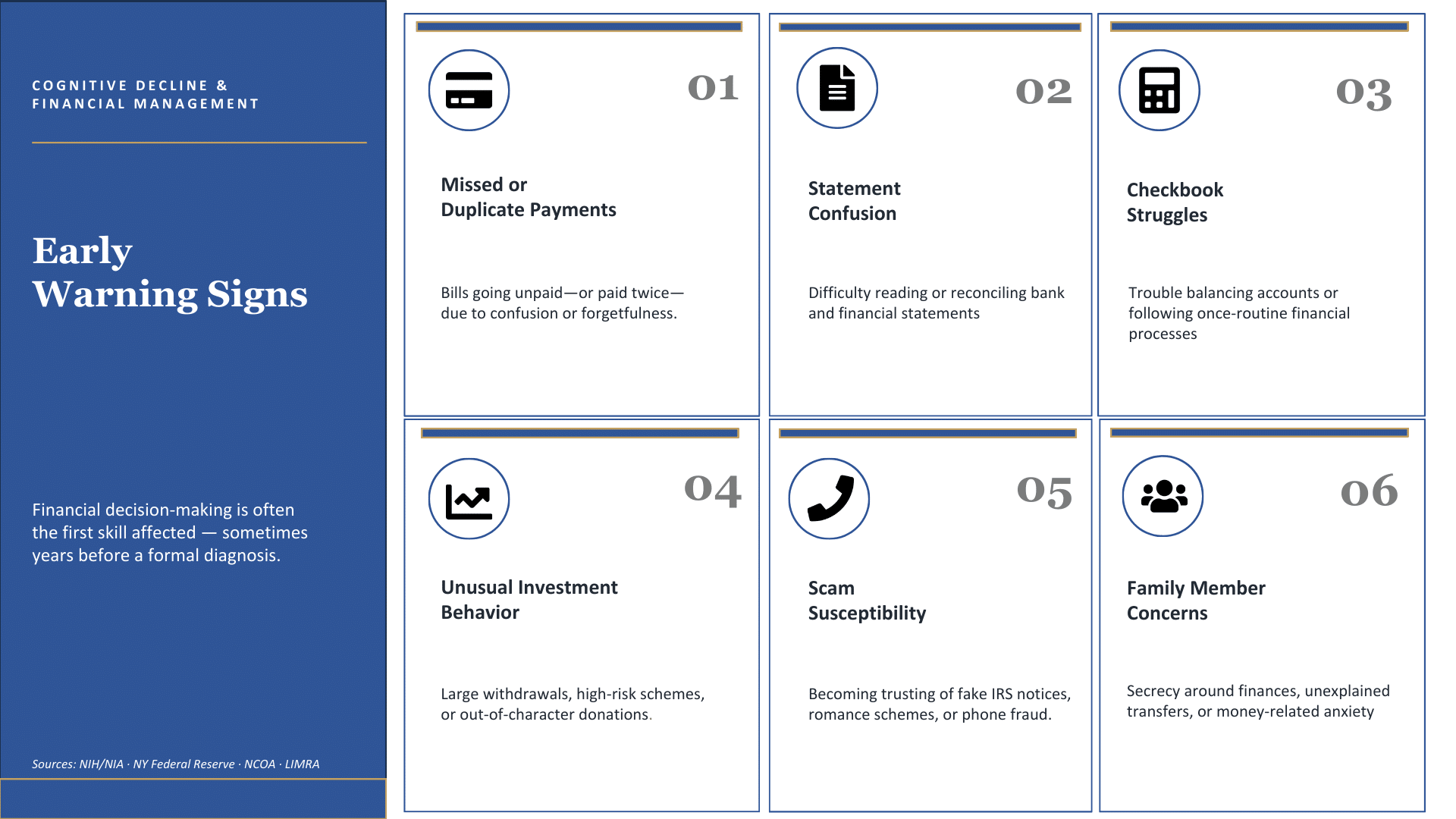
Cognitive decline is a natural part of aging—but its effects on financial management can be profound and, without proper planning, costly. Financial decision-making is among the first skills affected, often years before a formal diagnosis of Alzheimer’s or dementia.1 For families with accumulated wealth, understanding this risk and acting early is one of the most important aspects of long-term estate planning and wealth management.
Learn How Can Cognitive Decline Impact Financial Management?
How Does Cognitive Decline Affect Financial Decision-Making?
As the brain ages, several key capabilities begin to erode that directly affect a person’s ability to manage money effectively:
Executive function. Diminished capacity to plan and reason makes it harder to oversee financial portfolios or evaluate investment strategies.
Slower processing. Financial tasks become error-prone, increasing the risk of missed deadlines, duplicate payments, or missed required minimum distributions (RMDs).
Shifting risk tolerance. Older adults may become overly conservative or more susceptible to risky investment behavior due to impaired judgment.
Spousal vulnerability. When one partner handles all finances and experiences cognitive decline, the other may suddenly face financial and retirement income decisions without preparation.
Managing Finances with Alzheimers, Dementia, or Other Cognitive Issues
The earlier you speak with your BLBB advisor about safeguards, the better. While full legal capacity remains, proactive steps include:
Executing a durable power of attorney (POA) for finances
Establishing a revocable living trust
Simplifying and automating financial management processes
Introducing trusted family members to your wealth advisor and attorney
Waiting until a diagnosis is confirmed significantly narrows available options and can severely complicate estate planning. Acting early preserves both autonomy and financial security.
Early Financial Warning Signs Families May Notice2
The Financial and Estate Planning Risks of Cognitive Decline
Research from the New York Federal Reserve3 has documented significant financial harm from undiagnosed memory disorders—often accumulating before anyone realizes there is a problem. Key risks include:
Elder financial abuse. Exploitation often causing millions of dollars in irreversible losses.
Wealth transfer mistakes. Impulsive gifts or estate changes that conflict with established planning intentions.
Income mismanagement. Missed RMDs or IRS obligations that trigger penalties and erode wealth.
Guardianship risk. Without a durable power of attorney, families may face costly court proceedings to establish legal financial authority.
Family conflict. Undefined authority can create disagreements at an already difficult time. Asset protection requires planning before it is needed.
Proactive Safeguards: Wealth Advisor, Power of Attorney, Trusts, and Estate Planning4
Success A comprehensive incapacity plan combines legal documents, financial structures, and a coordinated team. Core components include:
Durable Power of Attorney for Finances. Designates a trusted individual to manage financial affairs if you become unable to do so. Must be executed while you are fully competent—the durable version remains effective after incapacity, unlike a standard POA. IRS Form 28485 should also be coordinated for tax matters.
Revocable Living Trust. Assets held in a funded revocable trust pass to a named successor trustee without court involvement, allowing easier financial management if capacity declines. The grantor retains full control while competent.
Advance Directives and Living Wills. Address healthcare and end-of-life preferences, relieving family members of impossible decisions and ensuring your wishes are honored.
Simplified Financial Systems. Consolidating accounts and automating bill payments reduces risk and makes oversight easier for a successor trustee or agent.
A Trusted Advisory Team. Your BLBB wealth advisor, elder law attorney, and informed family members—supported by fraud alerts and account monitoring—form the strongest line of defense.
Trusted Contact. Insure each member of your advisory team has the name and contact information for an individual that can be contacted in the event you cannot be reached.
Having the Conversation with Family Members
Discussing incapacity planning feels uncomfortable for many families—but the cost of avoiding it is far greater. When framed as stewardship rather than a shift in control, estate planning for incapacity becomes an act of care. To approach it well:
Involve adult children early. Introduce them to your BLBB wealth advisor and attorney while you are fully in control, so they know who to call and where documents are located. BLBB’s Life Organizer can help record valuable contact, medical and financial information all in one place.
Frame it as stewardship. Proper planning preserves your autonomy—ensuring your wishes, not a court’s, govern what happens.
Use your BLBB Wealth Advisor as an advocate. A skilled advisor can serve as a neutral guide, helping frame planning for incapacity as a natural part of aging parents’ finances—not a crisis.
If you are uncertain whether your existing POA, estate planning documents, and wealth management structures are adequate, now is the right time to find out.
Schedule a confidential review with a BLBB advisor (215-643-9100) to ensure your safeguards are in place while you are fully in control.
Recap FAQ
Q: When does cognitive decline begin to affect financial management?
A: Financial decision-making is often among the first skills affected, sometimes years before a formal medical diagnosis. Early signs may include missed payments, double payments, statement confusion, and increased susceptibility to elder financial abuse.
Q: What legal documents are most important for protecting finances during cognitive decline?
A: A durable power of attorney for finances and a revocable living trust are the two most critical documents. Together, they allow a trusted person to help manage your financial affairs without court intervention, preserving your intentions and protecting assets.
Q: How should families start the conversation about incapacity planning?
A: Frame it as stewardship, not control. Introducing adult children or trusted family members to your BLBB Wealth Advisor and professional support network while you are fully capable can ensure continuity and prevent conflict later.
BLBB does not provide tax advice. Clients are encouraged to consult their tax adviser.
Investment advisory services are provided by BLBB Advisors, a Pennsylvania-based investment advisor registered with the Securities and Exchange Commission under the Investment Advisers Act of 1940. SEC registration does imply any particular level of skill or training. Additional information about BLBB is available in our current disclosure documents which are available on BLBB’s website (www.blbb.com) or the SEC’s public disclosure database (IAPD) at www.adviserinfo.sec.gov.
Past performance is not indicative of future results and investing involves a risk of loss, including a loss of principal.
BLBB’s investment approach may incorporate, among other things, asset allocation and portfolio diversification. While these strategies are designed to limit risk, there is no guarantee that such strategies alone, or in combination, will guarantee against a loss of principal.
Subscribe to Our Updates
Subscribe to our newsletter to read our latest insights.