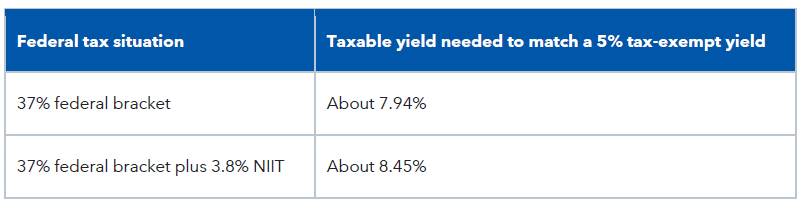
For investors in the top federal tax bracket, a 5% municipal bond can match a taxable bond yielding about 7.94%.
When the 3.8% Net Investment Income Tax (NIIT) also applies, the match rises to about 8.45%.
At lower yields, the tax advantage of a municipal bond can be modest. At 5%, the gap over comparable taxable bonds can be large enough to change how we think about the fixed-income part of a portfolio.
What Is Happening in the Bond Market Right Now?
Interest rates have moved higher this Fall.
The Federal Reserve raised its target range for the federal funds rate from 3.75% to 4.00% on September 16, 2026, its first increase since 20231.
On October 15, 2026, the 10-year Treasury par yield was 5.10%, and the 30-year was 5.43%2.
Municipal yields have followed. Municipal bonds are getting fresh attention from investors in higher tax brackets for several reasons:
Yields are near multi-year highs. Longer-term AAA municipal yields now sit at or above 5%.
Longer-term yields are noticeably higher than shorter-term yields. The curve rewards investors who are willing to extend maturities, though that also adds price risk.
Municipal bonds have become less expensive compared with Treasuries. Municipal-to-Treasury ratios sat above their 36-month medians at every maturity in one firm's October 2026 analysis3.
The interest is generally exempt from federal income tax. That makes the after-tax picture look even stronger.
Most investors focus on a bond's yield. For those in the top tax brackets, the better measure is the yield they keep after taxes. Contact a BLBB advisor to discuss why.
How Do Municipal and Treasury Yields Compare Today?
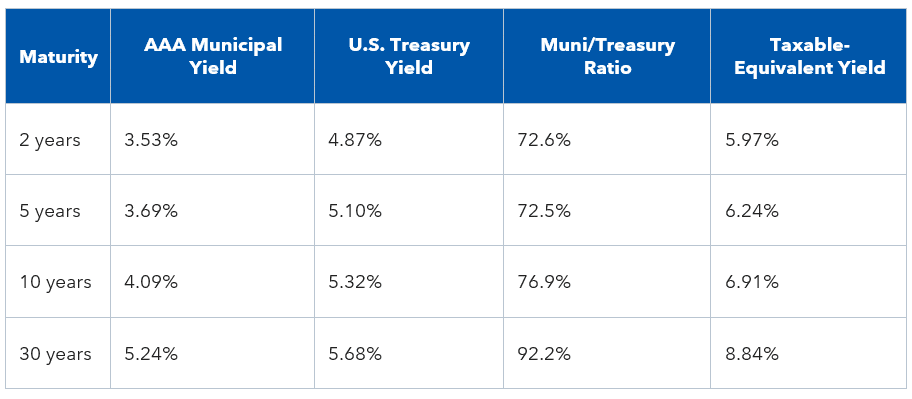
The table below shows where AAA municipal yields stood on October 1, 2026, alongside Treasuries and the taxable-equivalent yield for an investor in the top federal bracket plus NIIT (40.8%).
Source: Bloomberg data as of October 1, 2026, reported by Hennion & Walsh (hennionandwalsh.com). Taxable-equivalent yields exclude state and local taxes. Yields change daily.
Key takeaways
In this data, AAA municipal yields reach 5% only at the long end of the curve.
Reaching for 5% on shorter maturities usually means accepting more credit risk, which is rarely a good trade.
Higher yields have come with volatility. Investors pulled about $1.8 billion from municipal bond funds in the week of the Fed's decision, ending a 21-week streak of inflows.
This is not a forecast. When yields rise, the prices of existing bonds fall.
How Does the Tax-Equivalent Yield Work?
On $1 million invested at 5%, a municipal bond produces $50,000 a year in income that is exempt from federal income tax.
To keep the same $50,000 after taxes, an investor in the 37% tax bracket would need a taxable bond yielding about 7.94%.
If the 3.8% NIIT also applies, the taxable bond would need to yield about 8.45%.
Are Municipal Bonds Right for Every Investor?
No. Consider the following:
Tax bracket: For investors in lower brackets, taxable bonds often provide a better after-tax result.
Credit risk: A high yield is not a reason to take on more credit risk than you need.
Call, maturity, and liquidity: A bond that is called early may have to be reinvested at lower rates, and market value will move when interest rates change. Individual municipal bonds can also be harder to sell than Treasuries.
Alternatives: Treasuries and CDs are competitive in some situations. Treasury interest is generally exempt from state income tax, which can matter in high-tax states.
Tax-exempt income still counts elsewhere: It can affect certain income measures, so it belongs in your broader tax planning.
The right approach depends on your tax bracket, your state, your time horizon, and the rest of your portfolio. A BLBB advisor can compare your options before you commit.
Frequently Asked Questions
How is the tax-equivalent yield calculated?
Divide the municipal yield by one minus your tax rate.
37% bracket: 5% divided by 0.63 is about 7.94%.
37% bracket plus 3.8% NIIT: 5% divided by 0.592 is about 8.45%.
Why do 5% municipal bonds matter now?
Higher rates this fall have lifted municipal yields, particularly at longer maturities. For investors in the top brackets, those yields can compare favorably with taxable bonds after taxes.
Should municipal bonds be held in an IRA?
Generally, no.
The value of a municipal bond is its tax exemption.
Income inside an IRA or other tax-deferred account is not taxed currently.
Holding municipal bonds in an IRA usually means accepting a lower yield without a tax benefit.
Are municipal bonds safe?
Most of the municipal market is made up of high-quality issuers, but credit quality varies by issuer, and prices fall when interest rates rise.
Are municipal bonds right for every high net worth investor?
No. The benefit depends on your tax bracket, state, and time horizon, and a Treasury or CD ladder may be the better choice for some investors.
Compare Your Taxable Bond Income
Put your bond income to the after-tax test with BLBB Advisors so you can move forward with purpose and confidence.
Investment advisory services are provided by BLBB Advisors, a Pennsylvania-based investment advisor registered with the Securities and Exchange Commission under the Investment Advisers Act of 1940. SEC registration does not imply any particular level of skill or training. Additional information about BLBB is available in our current disclosure documents which are available on BLBB’s website (www.blbb.com) or the SEC’s public disclosure database (IAPD) at www.adviserinfo.sec.gov.
Past performance is not indicative of future results and investing involves a risk of loss, including a loss of principal.
BLBB does not offer legal or tax advice. Please consult the appropriate professional regarding your individual circumstances.
Bonds are subject to interest rate risk. As the prevailing level of bond interest rates rise, the value of bonds already held in a portfolio declines. Portfolios that hold bonds are subject to declines and increases in value due to general changes in interest rates.
Subscribe to Our Newsletter
Click below to receive our latest insights on a variety of financial topics