

Money Notes

Money Notes
In today's evolving workplace, more professionals are receiving compensation packages that extend beyond a simple salary, and many employers are using this type of compensation as an incentive. Variable compensation may rely on achieving specific goals, individual or team pay-for-performance or company profitability. While these arrangements can significantly boost your earning potential, they also introduce the need for a discussion with your BLBB advisor who understands your options and can develop a comprehensive strategy that accounts for irregular income, tax optimization, retirement planning, and long-term wealth building. Whether you're receiving stock options, Restricted Stock Units (RSU), deferred compensation, or performance-based bonuses, the decisions you make today may have profound impacts on your financial future.
Contact us to schedule a consultation for personalized guidance.
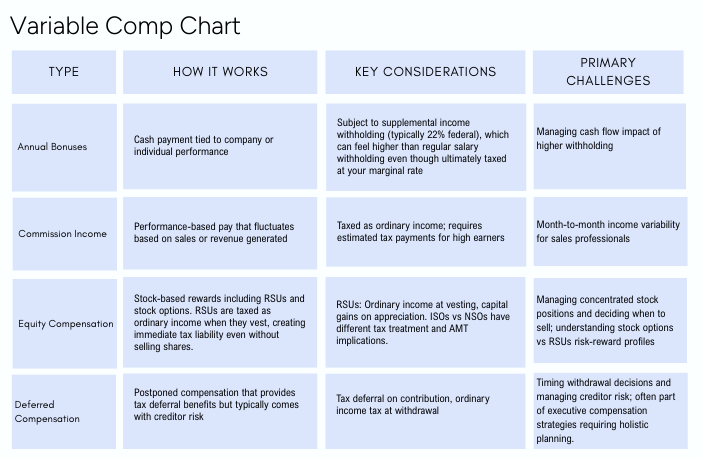
Variable compensation programs come with distinct characteristics, tax implications, and strategic considerations.
This irregular income stream requires disciplined budgeting and cash flow management to avoid the feast-or-famine cycle that derails many high earners.
Professionals who achieve the greatest long-term financial success aren't necessarily those who earn the most variable compensation—they are the ones who understand their options early and integrate them strategically into a comprehensive financial plan.
One of the greatest challenges for those with variable compensation packages is how to budget for the irregular income. The key is establishing a base budget built around your most conservative income estimate—typically your base salary or minimum guaranteed commission. This ensures your essential expenses remain covered during lean months.
When variable income arrives, you want to implement a strategic allocation approach. Consider, by way of example, the 50-30-20 framework adapted for irregular income:
This systematic approach can help prevent the common pitfall of lifestyle inflation that occurs when spending rises to match peak income periods.
While bonuses and salary are ultimately taxed at the same rates, bonuses face supplemental wage withholding (typically 22% federal for amounts under $1 million).1 Understanding how your employer calculates bonus tax withholding can help you plan appropriately—recognizing you may owe more at tax time if your marginal rate exceeds the withholding rate.
For non-cash equity compensation, timing becomes paramount. Understanding how RSUs are taxed starts with recognizing that vesting triggers ordinary income tax. However, the holding period for any shares you retain after vesting determines whether future gains receive long-term capital gains treatment. Strategic planning around RSU tax strategies might include selling enough shares at vesting to cover tax liability while holding a portion for potential appreciation.
When to exercise stock options depends on multiple factors: your company's prospects, Alternative Minimum Tax (AMT) considerations (for ISOs), current tax rates, and diversification need. For employees with company stock in 401(k) plans, understanding net unrealized appreciation (NUA) may unlock significant tax savings when distributed in-kind rather than rolled over.
Variable compensation may create a unique opportunity for accelerating your retirement timeline and building wealth strategically:
Success with variable compensation requires discipline and pre-commitment strategies. Consider implementing these approaches:
How you manage variable compensation can define your financial trajectory. While the complexity of modern compensation packages might seem overwhelming, the right strategies transform these vehicles from sources of stress into powerful wealth-building tools.
Time is your greatest ally when it comes to variable compensation planning. Every year you delay in integrating these strategies costs you tax efficiency, compounding growth potential, and financial flexibility. Many professionals who build significant wealth through variable compensation share a common trait: they seek comprehensive financial planning guidance early, before critical decision points arise, not after.
The key is developing a comprehensive plan that addresses all aspects—from cash flow management with irregular income to sophisticated tax strategies around equity compensation and deferred compensation plans. Your specific situation—your income volatility, equity structure, tax bracket, and financial goals—demands customized solutions that generic advice cannot provide.
Don't navigate these complexities alone. Together, we can tailor a customized plan to optimize tax efficiency, manage cash flow effectively, accelerate your financial goals, and transform your variable compensation from a source of uncertainty into your greatest wealth-building asset.
1https://www.experian.com/blogs/ask-experian/how-are-bonuses-taxed/
Disclosures
BLBB does not provide tax advice. Clients are encouraged to consult their tax adviser.
Investment advisory services are provided by BLBB Advisors, a Pennsylvania-based investment advisor registered with the Securities and Exchange Commission under the Investment Advisers Act of 1940. SEC registration does not imply any particular level of skill or training. Additional information about BLBB is available in our current disclosure documents which are available on BLBB’s website (www.blbb.com) or the SEC’s public disclosure database (IAPD) at www.adviserinfo.sec.gov.
Past performance is not indicative of future results and investing involves a risk of loss, including a loss of principal.
BLBB’s investment approach may incorporate, among other things, asset allocation and portfolio diversification. While these strategies are designed to limit risk, there is no guarantee that such strategies alone, or in combination, will guarantee against a loss of principal.
Subscribe to our newsletter to read our latest insights.