

Economic Review

Economic Review
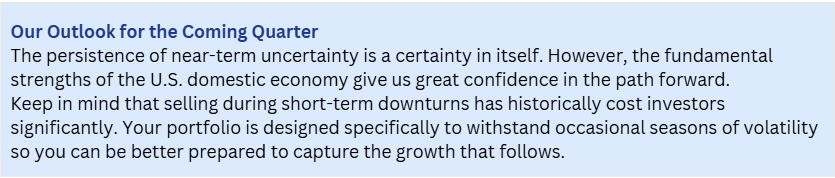
We enter the second quarter of 2026 accompanied by a familiar but nevertheless unsettling companion: economic uncertainty. Relative stability has given way to volatility. Yet the fluctuations we’re experiencing are a normal part of a healthy market’s in-and-out breathing pattern.
Our job as your advisor is to filter out all the noise and focus on the structural underpinnings of your wealth so you can make more calm, informed decisions. So, let’s take a look at some of the factors that may impact the coming quarter and the year ahead:


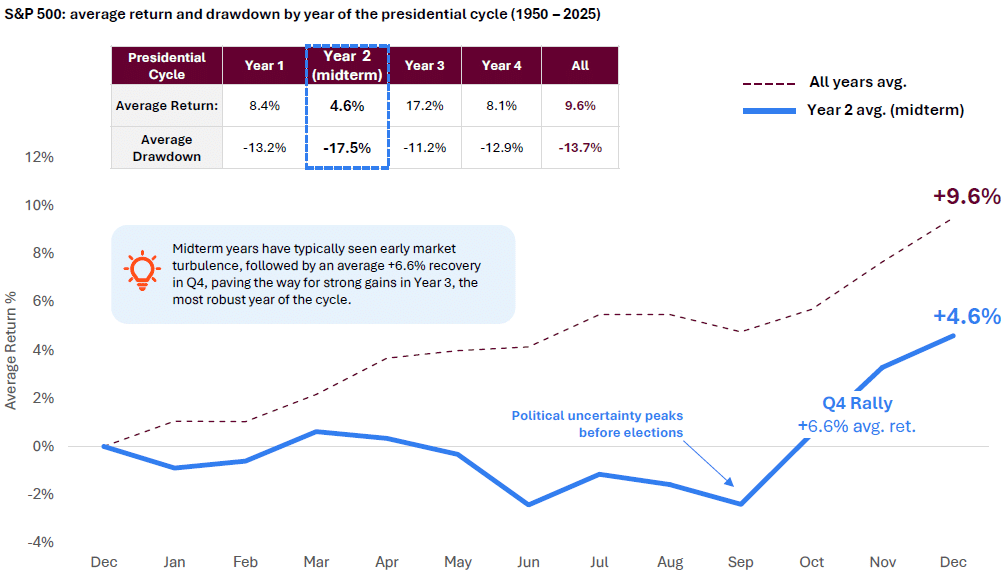
What this chart shows:
This chart shows the S&P 500's typical path through the four-year Presidential Cycle. It highlights the unique volatility of “Year 2” (midterms) compared to the long-term historical average of all years since 1950.
Why it matters:
Midterm years are notoriously the “choppiest” phase of the presidential cycle, seeing an average intra-year drawdown of -17.5% as political uncertainty impacts sentiment. However, history shows this volatility is often followed by a robust recovery in Q4.
Staying the course through seasonal turbulence has often been the key to capturing both the Q4 rally and the transition into Year 3, which has historically been the strongest year of the entire four-year Presidential cycle.
Source: Morningstar, analysis by Lincoln Financial. S&P 500 price return index, does not include dividends. February 2026



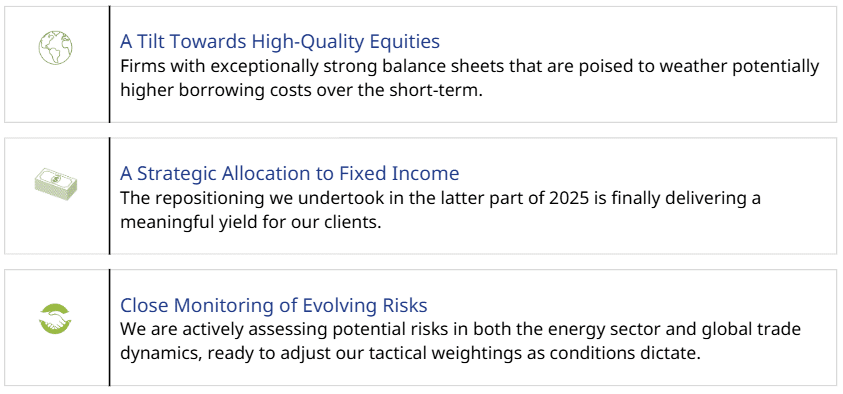
Our firm’s current positioning accounts for this by prioritizing domestic quality and international exposure where appropriate.

Despite the numerous headwinds the U.S. economy is facing, we're watching each of the following closely since they all have the potential to impact your portfolio:
| 1. Labor Market Resiliency The American worker continues to be our economy’s greatest asset. The latest data shows an unemployment rate remaining near historic lows at 4.4%. More importantly, we are seeing real wage growth – gains that are finally outpacing inflation – which should sustain the consumer's capacity to spend, even in a higher-price environment. |
| 2. Strong Consumer Balance Sheets Consumer spending accounts for roughly 70% of U.S. GDP, and that backbone remains solidly intact. While we’ve seen a slight uptick in credit card delinquency rates (returning to pre-pandemic norms), overall household net worth is at an all-time high ($175.25 trillion). |
| 3. Still On Track for a “Soft Landing” The Fed’s current posture is one of watchful stability. With the Fed Funds rate held steady, and the Personal Consumption Expenditures (PCE) price index trending higher than the 2% target, the "higher for longer" narrative has actually become a signal of confidence. The transition from "crisis management" to "steady-state" is a hallmark of an economy finding its footing. |
At BLBB Advisors, our investment philosophy remains anchored in three pillars: diversification, quality, and a long-term horizon. We do not manage portfolios for the next quarter; we manage them for the next decade.
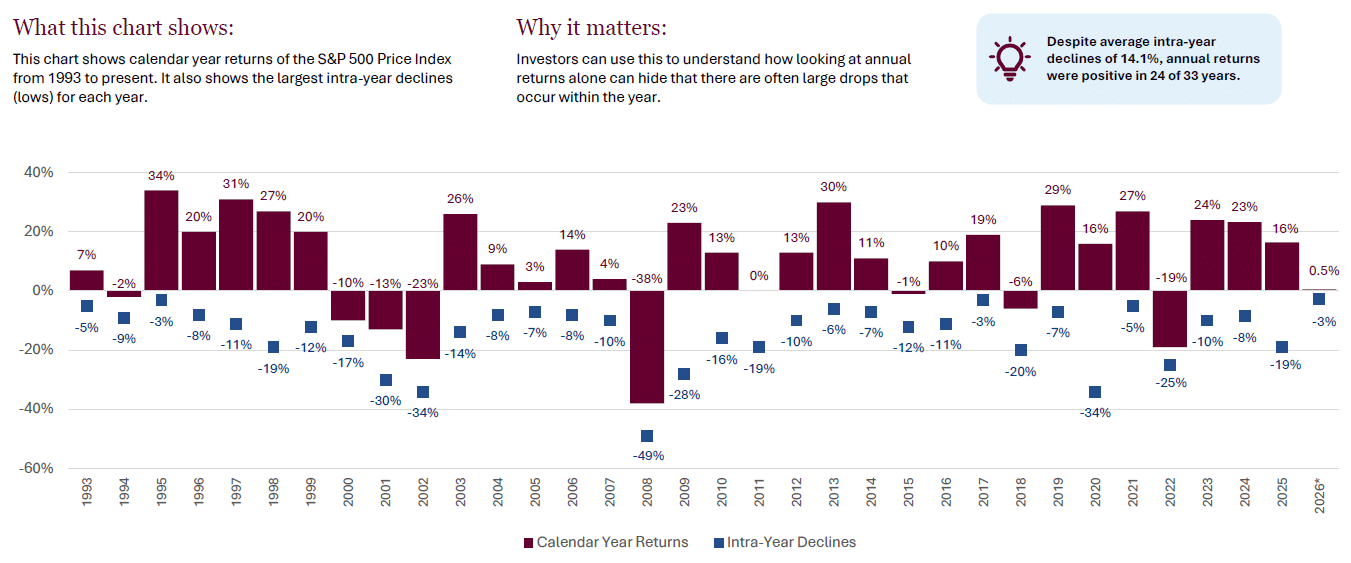
Source: Morningstar, Standard & Poor’s, data as of February 27, 2026
Contact your BLBB wealth advisor for more information
We're here to help you navigate these uncertain times with confidence.
1 https://www.bls.gov/charts/employment-situation/civilian-unemployment-rate.htm
Disclosures
Investment advisory services are provided by BLBB Advisors, a Pennsylvania-based investment advisor registered with the Securities and Exchange Commission under the Investment Advisers Act of 1940. Additional information about BLBB is available in our current disclosure documents which are available on BLBB’s website (www.blbb.com) or the SEC’s public disclosure database (IAPD) at www.adviserinfo.sec.gov.
This content is intended for informational purposes only and should not be construed as personalized investment advice. Please consult with your wealth adviser before making any investment decisions.
Certain information contained herein may be historical in nature while other responses may represent forward-looking statements. There are no guarantees that historical events will or may, repeat themselves. Forward-looking statements reflect the judgment of BLBB Advisors as of the date of publication and are subject to change without notice. They are not guarantees and involve risks, uncertainties, and assumptions that are difficult to predict.
BLBB’s investment approach incorporates, among other things, asset allocation and portfolio diversification. While these strategies are designed to limit risk, there is no guarantee that such strategies alone, or in combination, will guarantee against a loss of principal.
[View Quarterly Economic Review]
Click below to receive our latest insights on a variety of financial topics
Oops! We could not locate your form.