

Money Notes

Money Notes
As a parent, you want to give your child/grandchild every advantage. That includes a strong financial future — tax-advantaged savings accounts, college tuition, career training, a first investment, a financial foundation. Two savings vehicles — the time-tested 529 College Savings Plan and the newly proposed Trump 530A Account — offer complementary, tax-advantaged ways for parents and grandparents to invest in a child's future now. Understanding how each works, and how they can work together, is one of the smartest financial moves you can make.
Want to discuss the best way to save for your child or grandchild’s future? Contact us today.
A 529 Plan is a state-sponsored, tax-advantaged savings account designed specifically to help families save for education expenses. These plans have been available since 1996 and remain one of the most powerful and flexible tools in a growing family's financial planning toolkit.
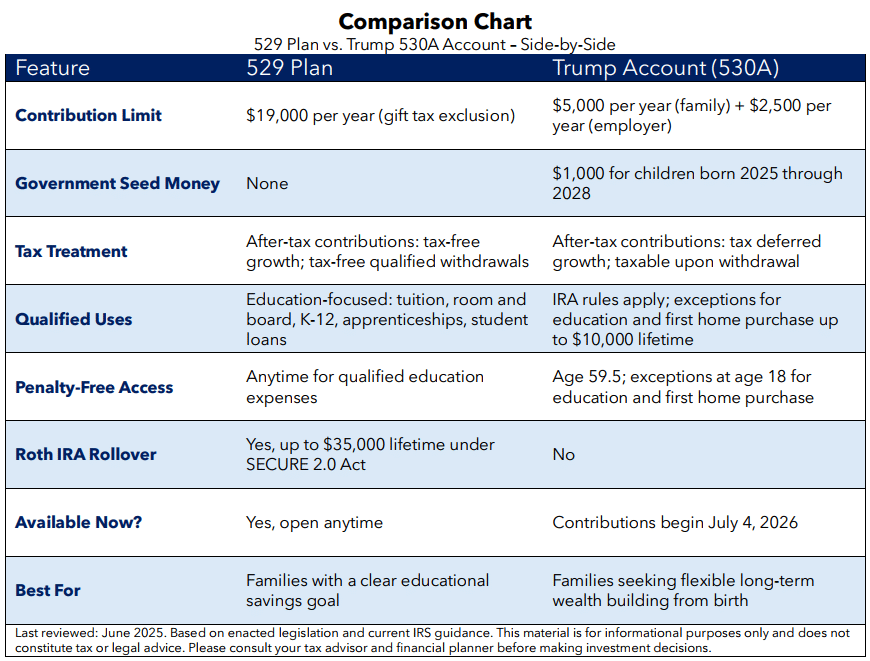
Contributions to a 529 Plan are made with after-tax dollars — meaning there is no federal income tax deduction for contributions. Your money grows tax-free, and withdrawals used for qualified education expenses are also completely tax-free at the federal level. Several states offer their own income tax deductions or credits for contributions to their state's plan, adding an additional layer of benefit.
Anyone can open a 529 Plan — parents, grandparents, aunts, uncles, even family friends — and name any individual as the beneficiary. There are no income limits to contribute, and contribution limits are generous. Under 2026 IRS gift tax rules, individuals can contribute up to $19,000 per year per beneficiary ($38,000 per year for married couples filing jointly) without triggering gift tax reporting.1 A powerful strategy called "superfunding" allows a one-time contribution of up to $95,000 per beneficiary by front-loading five years' worth of contributions in a single year.
529 Plans cover a wide range of qualified education expenses, including:
Starting in 2024, thanks to the SECURE 2.0 Act, a new valuable options was introduced: unused 529 funds can be rolled over into a Roth IRA2 for the beneficiary — up to $35,000 lifetime — eliminating much of the old fear about "what if my child doesn't go to college."
Key Benefits of the 529 College Savings Plan:
The One Big Beautiful Bill, enacted in 2025, built on that momentum by introducing Trump 530A Accounts.
Trump, also known as 530A Accounts, are a new type of tax-advantaged children's savings account introduced as part of federal legislation enacted in 2025 and the first contribution can be made as of July 4, 2026 (accounts can be opened now at trumpaccounts.gov or IRS Form 4547). These accounts represent an innovative approach to generational wealth-building by providing a financial foundation for your child.
Under the proposed legislation, every child born in the United States between January 1, 2025 and January 1, 2029, would be eligible to receive a one-time $1,000 government seed deposit into their Trump 530A Account at birth. Going forward, families, friends, and relatives could contribute up to $5,000 per year into the account. Contributions would be made with after-tax dollars, and the funds would be invested in a fund designed to track the US stock market — giving children broad exposure to long-term American economic growth.
The accounts would be tax-deferred, similar in structure to a traditional IRA, meaning contributions are not immediately taxed on their earnings, and growth compounds over time. The account is owned by the child but managed by an adult until the child reaches age 18. At that point, withdrawals would be subject to ordinary income tax — but the years of compounding growth in the interim make the long-term value substantial.
Unlike 529 Plans, Trump 530A Accounts are not restricted to education. Proposed eligible uses include:
This flexibility is a key differentiator — it acknowledges that not every child's path runs through a four-year university and that building wealth takes many forms.
Key Benefits to the Trump 530A Account:
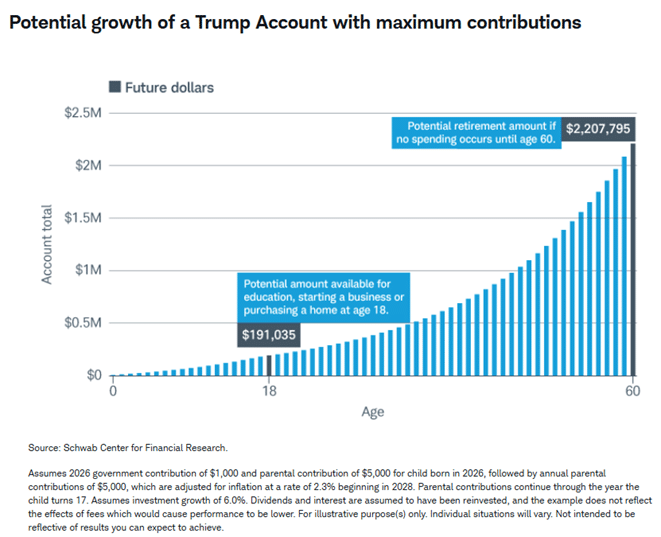
The 529 Plan and the Trump 530A Account are not competitors — they are partners. A family could open a 529 Plan immediately after a child's birth to begin building education-specific savings with tax-free growth, while simultaneously establishing a Trump 530A Account to capture the government seed deposit and begin building a broader investment base for the child's long-term future.
Together, these two accounts address different life goals and different financial timelines, giving your child maximum flexibility when they reach adulthood. Contact your BLBB wealth advisor at 215-643-9100 to start building a financial foundation for your child with clarity, purpose, and confidence.
Can I have both a 529 Plan and a Trump 530A Account for my child?
Yes, 529 Plans and Trump 530A Accounts are meant to be used together.
Will a 529 Plan affect my child’s financial aid eligibility?
Possibly, it depends on who owns the account, check FAFSA rules.
When can my child access their Trump 530A Account?
Beginning at age 18, account holders may access penalty-free funds.
Is a Trump 530A Account better than a 529 College Savings Plan?
They serve different purposes and the accounts are best used together, not compared as either/or options. Your BLBB wealth advisor can help you determine the right balance for your family's goals.
What happens to my child's Trump 530A Account if they do not use it for education or a home?
The account continues to grow on a tax-deferred basis, just like a traditional IRA, and can be accessed penalty-free at age 59.5.
Who can contribute to a Trump 530A Account?
Family members, friends, and employers can all contribute to a child's Trump 530A Account. Families may contribute up to $5,000 per year, and employers may contribute an additional $2,500 per year. The government provides a one-time $1,000 seed deposit for children born between January 1, 2025 and January 1, 2029.
Is the $1,000 government seed deposit into the Trump 530A Account automatic?
No, families can establish accounts through trumpaccounts.gov or by filing IRS Form 4547.
Do I lose any remaining balance from my child’s 529 Plan if they do not use it all or decide not to attend college?
No, starting in 2024, 529 unused funds are eligible for a ROTH IRA roll over up to a $35,000 lifetime limit.
Will a Trump 530A Account affect my child's financial aid eligibility?
Possibly, because the child owns that account, the account may be assessed at a higher rate than parent-owned 529 assets under FAFSA methodology. Official guidance has not yet been issued. Families with financial aid concerns should speak with their BLBB wealth advisor to model the potential impact before contributing.
What is the difference between tax-free and tax-deferred growth?
With a 529 Plan, your money grows tax-free, meaning you will never owe taxes on the earnings if withdrawals are used for qualified education expenses. With a Trump 530A Account, growth is tax-deferred, meaning you do not pay taxes on earnings each year, but you will owe ordinary income tax when you eventually withdraw the funds.
1 https://www.fidelity.com/learning-center/smart-money/529-contribution-limits
2 https://my529.org/secure-act-2-0/
Disclosure
Investment advisory services are provided by BLBB Advisors, a Pennsylvania-based investment advisor registered with the Securities and Exchange Commission under the Investment Advisers Act of 1940. SEC registration does not imply any particular level of skill or training. Additional information about BLBB is available in our current disclosure documents which are available on BLBB’s website (www.blbb.com) or the SEC’s public disclosure database (IAPD) at www.adviserinfo.sec.gov.
Past performance is not indicative of future results and investing involves a risk of loss, including a loss of principle.
BLBB does not provide tax advice. Clients are encouraged to consult their tax adviser.
Click below to receive our latest insights on a variety of financial topics